POINT OF INTEREST  HISTORICAL BUILDINGS

Castle of Montecchio Vesponi

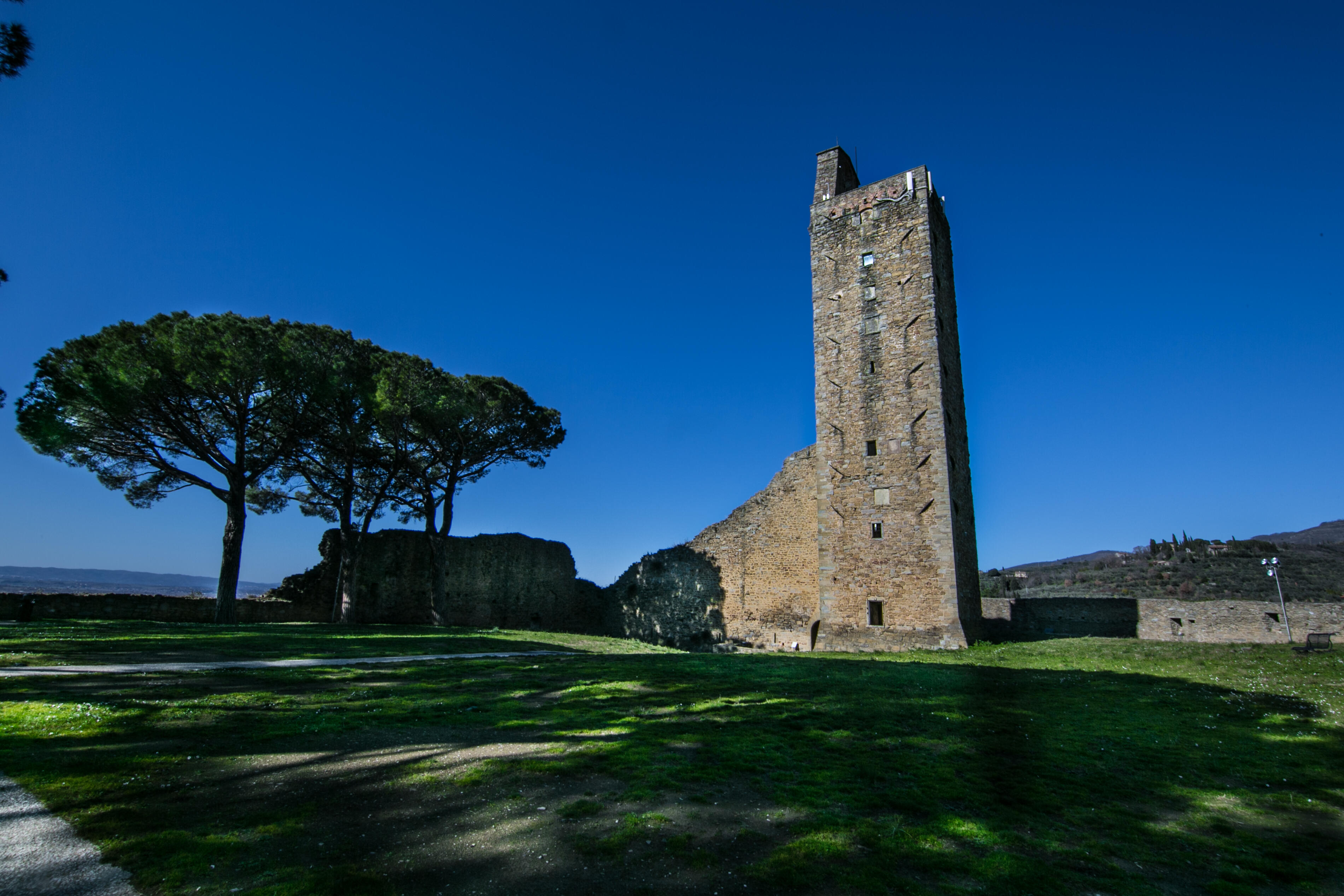
The Montecchio Vesponi Castle is one of the most evocative fortresses in all of Tuscany.

×

More information :

Built on a hill at the confluence of the Val di Chio and Val di Chiana, it served as a strategic point for controlling the ancient route between Arezzo and Cortona and the entire valley.

Immortalized in the backgrounds of some paintings by Fra Angelico, it still retains an imposing crenellated wall stretching 263 meters with nine watchtowers.

The toponym Monticulus refers to the modest height of the hill on which the castle stands; the name Vesponi may instead derive from the noble Arezzo family of the Guasconi, who owned it in the 11th century. The fortified settlement was first mentioned in 1014, ceded by the Abbey of Farneta to the Marquises of Monte Santa Mariai; the castle later became the subject of bitter disputes between Arezzo and Florence, who sought to consolidate their influence over the area.

The landscape surrounding Montecchio Vesponi Castle has been nominated for UNESCO World Heritage status.
How to Get Here

Address:

Localita Montecchio Vesponi 353
52043 Castiglion Fiorentino (AR)

View in Maps

Contacts

Below are our contacts through which you can reach us:

Share the page

Below are our references through which you can contact us:

You might also be interested in ...

Drag or swipe the images for a more immersive experience.

Church of the Good Death

The Company of Prayer and Death, or Company of the Good Death, was founded in 1572 to organize a service of prayer, transportation, and burial of the deceased.

View More

Bonifica Trail

Along the Canale Maestro della Chiana you can follow an equipped cycle/pedestrian path of approximately 62 km that connects Arezzo with Chiusi

View More

Church of San Francesco

The church, overlooking the square of the same name, was built by the Franciscans in the mid-13th century over a pre-existing 12th-century structure, first dedicated to San Salvatore and then to San Leonardo.

View More

Institute of Santa Chiara

The complex was founded in the 16th century, when the monastery of San Salvatore was incorporated, which underwent significant expansion after 1557.

View More

Cassero

Located in the highest part of the town, the Cassero complex dominates the entire Valdichiana and still retains its medieval defensive structure.

View More

Porta Romana

Anciently called Porta San Michele or Cortonese, Porta Romana represents the southern access to the city

View More

Church of Jesus

The building, constructed by the Congregation of the Most Holy Sacrament between 1527 and 1545, is adjacent to the ancient Parish Church of San Giuliano (Pieve Vecchia).

View More

Walks of Saint Francis

The Ways of St. Francis in Tuscany are a nearly 300-kilometer path that leads pilgrims and travelers to places linked to key episodes in the life of the Saint.

View More

Sanctuary of the Madonna del Bagno

Legend has it that Mary appeared to two young shepherdesses, asking them to build a chapel

View More

Palazzo Comunale

Political and administrative seat of Castiglion Fiorentino since the end of the 12th century, the Palazzo Comunale, or Palazzo San Michele, was rebuilt by the Perugians in 1375-76 and, subsequently, in 1489

View More